
🔌 Electronics & PCB
Printed circuit boards, flexible PCB and fine-line copper conductors.
Machines: PCB Etching Line · Double Etching · Auto Line
GE industrial etching machines are production-grade photochemical and chemical etching systems built for high-volume metal and PCB manufacturing. Every line ships with a sealed PP / PVC spray chamber, closed-loop etchant regeneration, PLC recipe control and full line automation — tolerances to ±0.01 mm, chambers from 600 × 800 mm up to 1500 × 3000 mm, plus continuous reel-to-reel.
A photo etching machine (also called a chemical etching or photochemical machining machine) reproduces fine patterns in metal without the tooling cost, burrs or stress of stamping and laser cutting. GE manufactures the full family of metal etching machines below — each available with single or double-sided spray etching, configurable etch area and your choice of etchant such as ferric chloride (FeCl₃) or cupric chloride (CuCl₂).
An industrial etching machine is a production-grade photochemical or chemical etching system designed for continuous, high-volume operation. Unlike a benchtop or laboratory unit, an industrial etching machine runs an 8-hour shift (or three-shift, 24/7) without intervention, holds the etchant at constant strength through a regeneration loop, and integrates with upstream coating / exposure and downstream strip / dry stations into one automated production line.
GE has manufactured industrial etching machines in Beijing since 2003, exporting to the USA, India, the UAE, Turkey and 45+ other countries. Every industrial etching machine below is built for one of three production regimes — single-sided, double-sided or reel-to-reel — and is available with chamber sizes from 600 × 800 mm to 1500 × 3000 mm.
Both dissolve metal with the same chemistry — but the engineering and economics are very different. Use this comparison to decide whether you need a true industrial etching machine or a smaller benchtop unit.
| Parameter | Laboratory etching machine | Industrial etching machine |
|---|---|---|
| Chamber / etch area | ≤ 400 × 600 mm | 600 × 800 up to 1500 × 3000 mm; reel-to-reel to 8 m |
| Throughput | 1–10 panels / day | 100–2000+ panels / 8-h shift |
| Etchant regeneration | Manual dump-and-fill | Continuous closed-loop with ORP / Baumé control |
| Automation | Manual load / unload | PLC recipe control, conveyorized line, robotic load / unload |
| Tolerance | ±0.05 mm typical | ±0.01 mm to ±0.02 mm repeatable |
| Operator skill | Bench chemist / R&D | Production-line operator after 2-day training |
| Typical cost | US$ 5,000–15,000 | US$ 30,000–250,000+ depending on chamber size and automation |
Find the etching equipment for your field — each industry below lists the machines GE most often supplies for it.
Printed circuit boards, flexible PCB and fine-line copper conductors.
Machines: PCB Etching Line · Double Etching · Auto Line
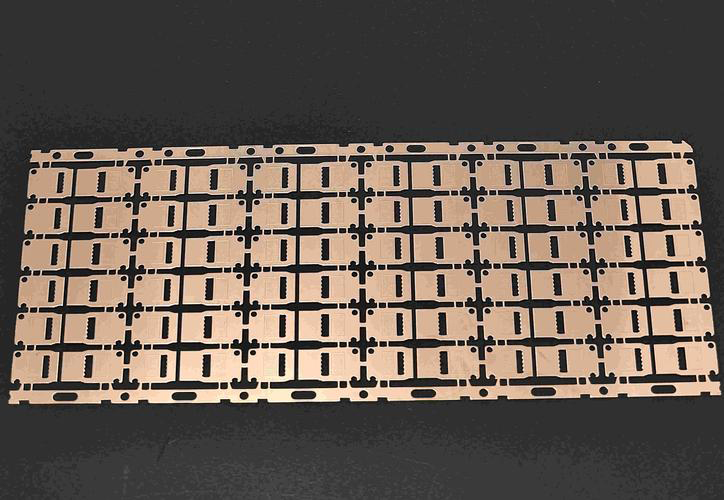
Lead frames, IC carriers, connectors and precision strip parts.
Machines: Reel-to-Reel · Precision Vertical
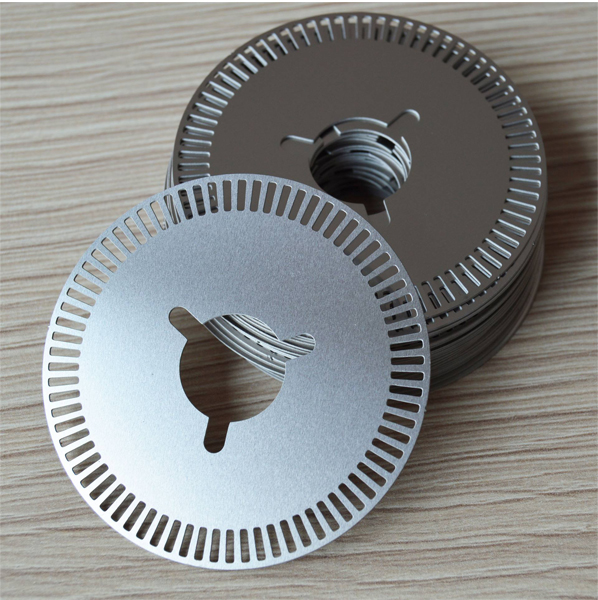
Shielding cans, board-level fingers and shielding gaskets.
Machines: Super Thin-Plate · Reel-to-Reel

Springs, shims, flexures, contacts and washers — burr-free, stress-free.
Machines: Precision Horizontal · Precision Vertical

Etched sieves, speaker meshes, filter discs and perforated foils.
Machines: Super Thin-Plate · Precision Horizontal
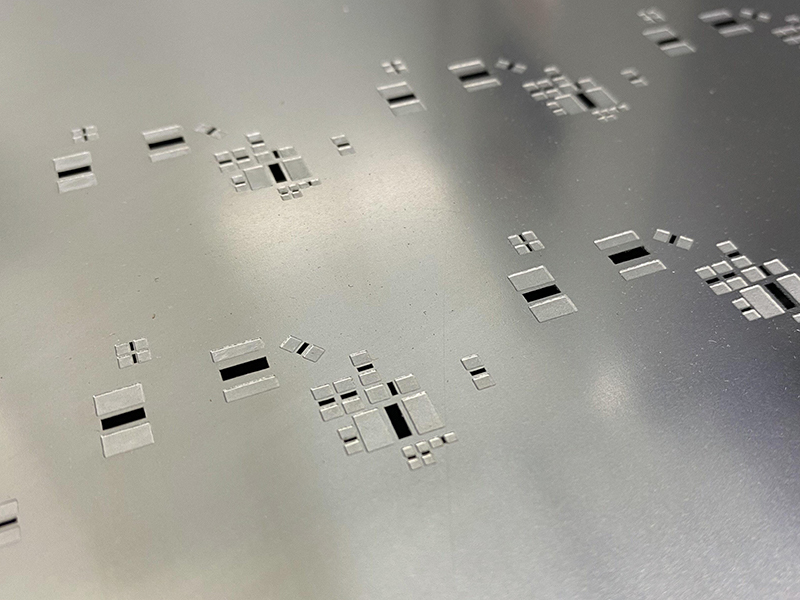
Solder-paste stencils, encoder discs, gratings and precision scales.
Machines: Precision Vertical · Super Thin-Plate

Etched and color-filled metal nameplates, badges and signage.
Machines: Single Etching · Double Etching

Etched stainless art, elevator panels and architectural sheet.
Machines: Huge Decoration Plate · Huge Plate Line
Watch dials and cases, lighters, badges and decorative jewelry.
Machines: Watchcase Etching · Cylinder Etching

Steel cutting-die moulds and hot-stamping / embossing dies.
Machines: Cutting Dies · Stamping Dies
Surgical blades, stents, implant meshes and micro-fluidic parts.
Machines: Precision Vertical · Super Thin-Plate
Gaskets, sensor parts, fuel-cell bipolar plates and battery foils.
Machines: Precision Horizontal · Reel-to-Reel · Super Thin-Plate
Standard specifications across the GE industrial etching machine range. Every parameter is configurable to your metal, panel size and throughput target.
An industrial etching machine is the workhorse wherever fine metal features must be reproduced at scale. The twelve industries below are GE's largest industrial etching machine customer base.
Inner / outer layer etching of multi-layer boards, flexible PCB, copper lead frames — most common industrial etching machine application by unit volume.
Lead frames, IC carriers and QFN / DFN packages demand ±0.01 mm — reel-to-reel industrial etching machine with inline AOI.
Board-level shielding cans and contact fingers — beryllium copper and stainless, often 0.05–0.2 mm strip.
Gaskets, sensor shims, fuel-cell bipolar plates, battery current-collector foils — high-volume industrial etching machine lines for new-energy OEM.
Turbine shims, encoder discs, lightweight alloy panels — must hold tight tolerance on titanium and Inconel alloys.
Surgical blades, stents, bone plates, micro-fluidic chips — burr-free, stress-free parts at medical-grade cleanliness.
Etched sieves down to 20 µm aperture, speaker grilles, fuel-injection screens — industrial etching machine with thin-plate option.
Elevator panels, art panels, large-format façade sheets — needs industrial etching machine with 1.5 × 3 m chambers.
Anodized aluminium and stainless nameplates with color-fill — mid-volume, double-sided industrial etching machine.
Steel rule dies and hot-stamping dies — used to make the dies that the packaging industry cuts with.
Watch dials, cases and decorative parts — small batches, fine detail, brass and stainless.
Polyimide-based flexible circuits and copper-clad flex — reel-to-reel industrial etching machine for strip widths 25–250 mm.
Five questions that pin down the correct industrial etching machine for your line. Work through them in order — by the end you'll know the chamber size, etchant, automation level and budget you need to specify.
Stainless, copper, brass and aluminium share the FeCl₃ / CuCl₂ family and can run on one industrial etching machine. Titanium needs HF chemistry and an immersion-style tank with a wet scrubber — not a spray chamber. Foil under 0.1 mm wants a thin-plate industrial etching machine with gentle handling. Plate over 2 mm is slow on spray and benefits from immersion or a hybrid line.
The largest panel drives the chamber. The tightest tolerance drives the agitation method — spray for ±0.02 mm and finer, immersion for ±0.05 mm and looser. For HDI PCB at ±0.01 mm, only the precision horizontal or vertical industrial etching machine will hold it across a full 650 × 800 mm panel.
Volume per shift picks the automation level. Below 50 panels per shift, a single industrial etching machine with manual load is enough. 50–500 panels per shift wants a semi-auto industrial etching machine with auto load / unload. Above 500 panels per shift needs a full conveyorized line with etchant regeneration and SCADA reporting.
Single-sided for nameplates, signage and decorative panels. Double-sided for PCB and any part etched from both faces simultaneously. Reel-to-reel for lead frames, EMI strip, and FPC — the strip runs continuously through the industrial etching machine, no individual panel handling.
An industrial etching machine needs three-phase power, a 800–2000 CFM exhaust with face velocity ≥ 0.5 m/s, DI water < 5 µS/cm, and a chemistry containment slab rated for 110% of the bath volume. If your site can't meet these, an industrial etching machine is the wrong starting point — start with a fume-hood bench unit and scale up only when the site is ready.
The full family of GE metal etching machines — every one can be tailored to your material, size and volume.

Entry-level etching machine for signs, plates and short runs.
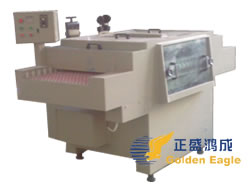
Two-side simultaneous spray etching for PCB and nameplates. View full specifications →

High-accuracy etching for precision metal parts. View full specifications →
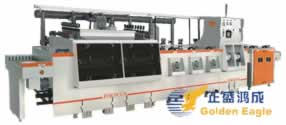
Conveyorized line for continuous high-volume etching. View full specifications →
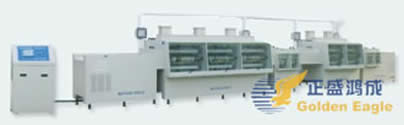
Full etch-and-strip line for printed circuit boards. View full specifications →

For SMT stencils, gratings and encoder masks. View full specifications →

Photoengraving for steel cutting-die moulds.

Special for stamping mould and hot-stamping dies.

Large-format etching for decorative metal panels.

Continuous line for etched decoration plate. View full specifications →

Etches round workpieces, rollers and tubes. View full specifications →

Photoengraving for watchcases and small metal goods. View full specifications →

For ultra-thin shims, meshes and foils. View full specifications →
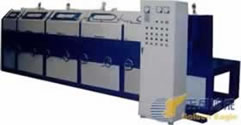
Continuous strip etching for lead frames & connectors. View full specifications →
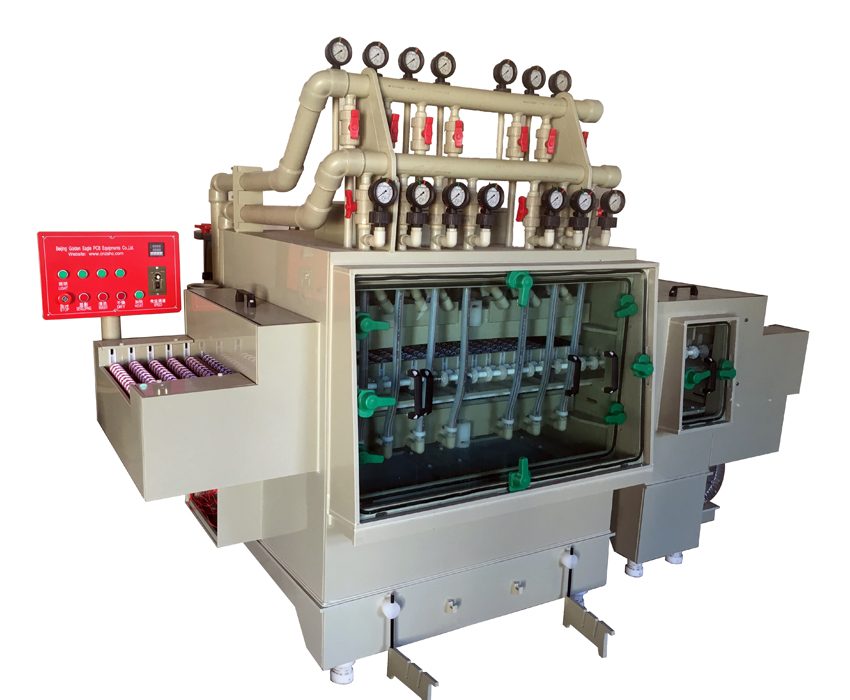
Double-side oscillating spray etching for FR4, aluminium PCB and thin copper — full automatic line with conveyorised load → etch → wash → unload. See this model in the PCB equipment range.
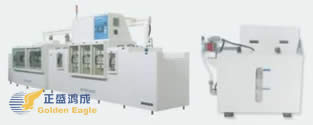
CuCl₂ conveyorised line for double-sided / multi-sided PCB and thin copper — high precision, closed-loop chemistry. View full specifications →

FeCl₃ conveyorised line for PCB and stainless / copper sheet etching — high etch rate, stable regeneration. View full specifications →
17 etching machine models — and every one can be tailored to your material, size and volume.
Repeatable precision for the finest features.
Benchtop to 1500×3000 mm and 8 m reels.
PP/PVC build for FeCl₃ & CuCl₂ chemistry.
We hand over the full etching process know-how.
Use these deep-dive pages to spec the right machine, chemistry and tolerance for your industry.
An industrial etching machine is a production-grade photochemical or chemical etching system built for continuous, high-volume operation. Compared with a laboratory etching machine, it has a sealed spray or immersion chamber of 600 × 800 mm or larger, closed-loop etchant regeneration, PLC recipe control, and line-level automation. GE industrial etching machines are used in PCB, semiconductor, automotive, aerospace, medical and decorative-metal production lines worldwide.
A laboratory etching machine is typically a 400 × 600 mm bench unit used for R&D and short runs, with manual dump-and-fill chemistry. An industrial etching machine has a chamber of 600 × 800 mm up to 1500 × 3000 mm, continuous etchant regeneration, conveyorized handling, and tolerances held to ±0.01 mm. Throughput on an industrial etching machine is 100–2000+ panels per shift versus 1–10 on a laboratory unit.
It depends on the panel size, etch depth and chemistry, but a typical GE industrial etching machine with a 650 × 800 mm chamber and ferric chloride chemistry holds 100–200 panels per 8-hour shift on 0.5 mm stainless steel. The huge-plate industrial etching machine (1500 × 3000 mm) holds 30–60 large architectural panels per shift, and a reel-to-reel industrial etching machine processes 8 m of strip per minute.
An industrial etching machine using ferric chloride (FeCl₃) or cupric chloride (CuCl₂) processes stainless steel, copper, brass, nickel, mild steel and aluminium. Alkaline chemistry on a dedicated industrial etching machine line (GE-AE650) handles aluminium and copper at high etch rate. Titanium needs a hydrofluoric acid mix on a sealed immersion industrial etching machine with a wet scrubber — never on a spray line.
An industrial etching machine from GE ranges from US$ 30,000 for a single 600 × 800 mm chamber with semi-auto handling to US$ 250,000+ for a fully conveyorized 1500 × 3000 mm line with etchant regeneration, auto load / unload, and SCADA. The three cost drivers are chamber size, automation level, and chemistry choice. Shipping, installation and training are quoted separately.
An industrial etching machine on the GE-JM spray line holds ±0.02 mm in-plane etch depth variation across a full 650 × 800 mm panel. The precision vertical industrial etching machine (GE-JM-V) holds ±0.01 mm on SMT stencil and encoder applications. Reel-to-reel industrial etching machines hold ±0.02 mm across an 8 m strip with inline optical monitoring.
Yes. Every GE industrial etching machine ships with a closed-loop regeneration skid. For FeCl₃, chlorine gas is metered into the regen cell to convert Fe²⁺ back to Fe³⁺. For CuCl₂, air is sparged through the cell to oxidize Cu⁺ back to Cu²⁺. The industrial etching machine holds specific gravity within ±0.5° Baumé and free acid within ±5% of setpoint over an 8-hour shift, with no operator intervention.
Five questions determine the right industrial etching machine: (1) what metal and thickness, (2) what panel size and tolerance, (3) what throughput per shift, (4) single-sided, double-sided or reel-to-reel, and (5) what utility envelope (power, exhaust, DI water) is on site. GE applications engineers work through these on a 30-minute call and recommend a chamber size, chemistry and automation level. See the selection guide above for the full five-step framework.
Send your material, part size, tolerance and monthly volume — we'll spec the machine and quote within a day.