🔹 3003 (Al-Mn)
Most common. Mild etch, inhibitor added. Horizontal precision
Photochemical etching for 3003, 5052, 6061, 7075 & aluminium-alloy foils. Alkaline NaOH etchant with closed-loop Al(OH)₃ recovery — ±0.02 mm, burr-free, 0.05–1.5 mm. EV battery enclosures, signage, decor panels, satellite waveguides, nameplates & inverters.
Aluminium is etched in alkaline sodium hydroxide, not acid. The chemistry is mature, the etchant is regenerable, and the sidewall leaves a micro-rough surface that's perfect for anodising. GE aluminium etching lines are widely used for EV battery enclosures (where burr-free edges are a regulatory safety issue), decor panels, and aerospace waveguides.
Most common. Mild etch, inhibitor added. Horizontal precision
Marine grade. Standard NaOH. Bilge & fuel-tank shims.
Heat-treatable. Structural battery enclosures & cooling plates.
Airframe grade. Slower etch, NaOH + Na₂S activator. Aerospace line
Sensor mesh & EMI shields. Super thin-plate
Switched chemistry. PCB etching line
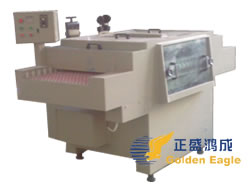
Workhorse for decor panels, signage, EV shims.

Built for ultra-thin foil that ordinary lines would tear.
Aluminium is etched in alkaline NaOH (or CuCl₂/ammonia for PCB inner-layers). Three GE machines cover the bulk of programmes.
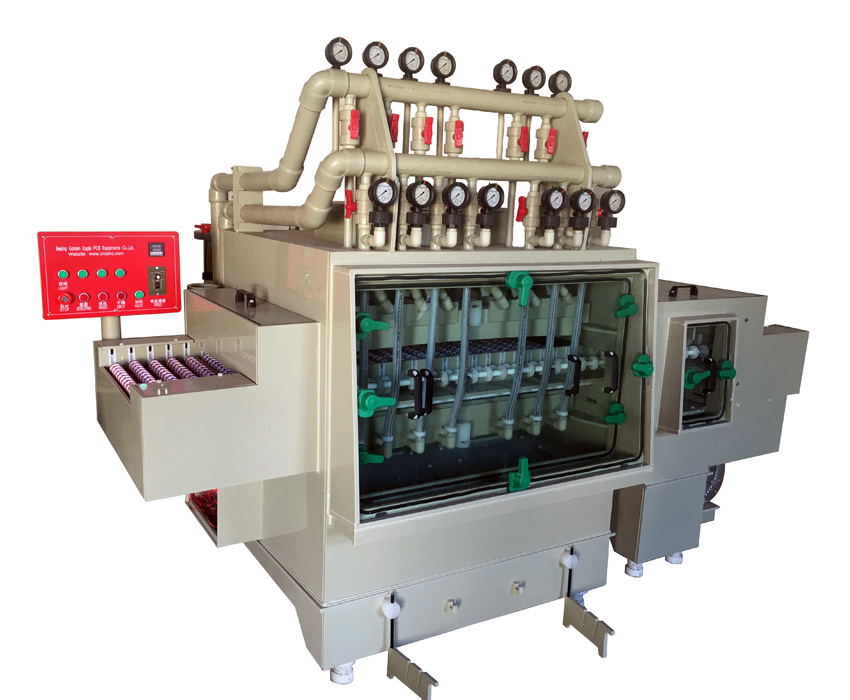
PCB alkaline etching: ammonia-based chemistry for HDI / multilayer boards.
| Etching process | Ammonia-based alkaline (CuCl₂ + NH₃) |
| Applications | Double-sided PCBs, LED, multilayer, thin copper |
| Power | 40 kW / 380 V / 50 Hz |
| Working width | 650 mm |
| Working height | 850 mm (+/-50 mm) |
| Min / Max board | 120 × 80 mm / 650 × 650 mm |
| Develop type | Double-spray oscillating |
| Workpiece thickness | 0.2–3.2 mm |
| Working temperature | 35–55 °C |
| Conveyor speed | 0.5–6 m/min |
| Heater / cooling | Titanium pipe |
| Dimension | 8000 × 1700 × 1850 mm |
Process flow: Load → CuCl₂/ammonia etch → regeneration → pressure water wash → squeeze → cold/hot dry → unload.
Heavy-duty NaOH etching for 1.0–1.5 mm aluminium panels and nameplates.
| Power | 15 kW / 380 V / 50 Hz |
| Etching width | 650 / 1000 / 1220 / 1550 mm |
| Thickness | 0.20–3.0 mm |
| Tolerance | ±0.05 mm |
| Spray | Double-side oscillating, 4 kW ×2 |
| Tank volume | 800 L PP-lined |
| Cabinet | PP, ≤100 °C |
| Dimension | 3850 × 1650 × 1550 mm |
Includes an Al(OH)₃ precipitation loop — turns sodium aluminate to sellable aluminium hydroxide.
For 650 × 650 mm decorative and signage work.
| Power | 5.5 kW / 380 V / 50 Hz |
| Etching size | 650 × 650 mm |
| Thickness | 0.05–5.0 mm |
| Spray | Top & bottom oscillating |
| Tank volume | 400 L |
| Cabinet | PP |
| Dimension | 1850 × 1650 × 1550 mm |
Aluminium is etched in alkaline NaOH (or ammonia-based for PCB inner-layer copper). The reaction releases H₂ gas — that's why every GE aluminium line ships with a sealed tank and a forced-exhaust hood. The H₂ also carries an aerosol of NaOH droplets, so the cabinet isn't optional. NaOH by itself is corrosive but not toxic; the ammonia version is worse on the nose and requires a wash-down module to drop NH₃ below 25 ppm before discharge.
The GE-AE650 was built originally for PCB inner-layer etching — the multiple-lane conveyor, the regenerable CuCl₂/ammonia loop and the dual-temperature zones are all PCB legacy. We adapted it to aluminium sheet by substituting the chemistry and dropping the lane-count; most aluminium-decor customers run one or two lanes at 0.5 m/min and never push the full 6 m/min capability.
Six things to read next — same chemistry, similar tolerances, or the next step in your process.
Same cabinet, NaOH vs FeCl₃ chemistry swap →
Same conveyor, alloy-swap cabinet →
Ti aerospace shims — overlap with Al in auto →
6061-T6 battery shims & cooling plates →
Al waveguides, Al 7075 airframe shims →
Aluminium spray etch at 650 mm width →
Tell us your alloy (3003 / 5052 / 6061 / 7075), sheet thickness and volume. We'll spec the NaOH loop, the Al(OH)₃ recovery and the cabinets.