🔹 CP-Ti (Grade 1–4)
Pure Ti. ~5% HF + HNO₃. Heat shields, foil gaskets. Super thin-plate
Photochemical etching for CP-Ti, Ti-6Al-4V (TC4) & titanium alloys. Hydrofluoric-acid-based chemistry, PFA-lined cabinets, closed-loop exhaust and full neutralisation loop — ±0.02 mm, burr-free, 0.02–1.0 mm. Aerospace heat shields, FCEV bipolar plates, medical implants.
Titanium is the most demanding metal on an etching line. The chemistry is HF-based (with HNO₃ to release the passivation layer); every wetted surface must be PFA or PTFE; hydrogen pickup needs to be controlled; spent acid must go through a calcium-gluconate neutralisation loop. GE has shipped titanium etching lines since 2011, originally for FCEV bipolar plates and aerospace heat shields.
Pure Ti. ~5% HF + HNO₃. Heat shields, foil gaskets. Super thin-plate
Workhorse alloy. ~8% HF + HNO₃ + activator. BPPs, ortho. BPP line
Tubing alloy. Acid blend tuned for tubing. Hydraulic & aerospace.
High-temperature alloy. Aerospace line
Biomedical / aerospace. Special chemistry on request.
Sensor mesh & acoustic webs. Super thin-plate

Workhorse for aerospace shims, medical implants, BPPs.

Built for ultra-thin Ti foil that ordinary lines can't handle.
Titanium is etched in HF chemistry — every wetted part must be PFA or PTFE, and the cabinet must be HF-grade.
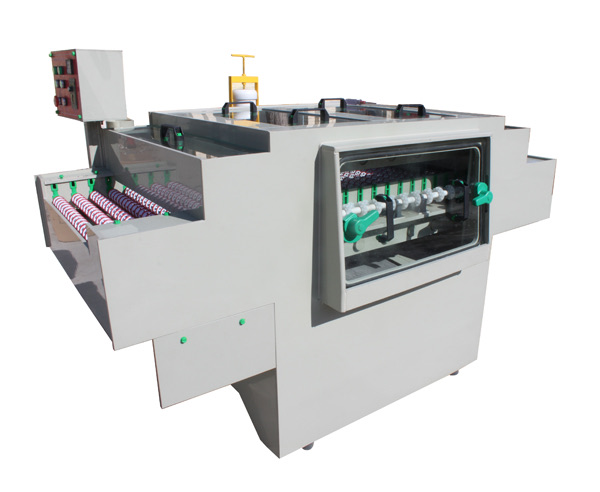
Conveyorised acid-based etching for titanium aerospace, medical, BPP work.
| Etching process | Acid-based (HF + HNO₃) for titanium |
| Power | 45 kW / 380 V / 50 Hz |
| Working width | 650 mm |
| Working height | 850 mm (+/-50 mm adjust) |
| Min / Max board | 120 × 80 mm / 650 × 650 mm (custom) |
| Develop type | Double-spray + oscillate |
| Workpiece thickness | 0.2–8.0 mm |
| Working temperature | 35–55 °C |
| Conveyor speed | 0.5–6 m/min |
| Cabinet | High-temp German PP, ≤100 °C |
| Machine dimension | 8000 × 1700 × 1850 mm |
Process flow: Load → HF/HNO₃ chemical etch → cascade water wash → Inspection → Strip → Cold & hot dry → Unload.
For stents, scalpels, orthodontic parts — bench-top titanium precision.
| Etch area | 650 × 650 mm |
| Thickness | 0.05–5.0 mm |
| Tolerance | ±0.02 mm |
| Spray | Top & bottom oscillating, 4 kW |
| Tank volume | 400 L PFA-lined |
| Cabinet | PP, ≤100 °C |
| Safety | HF sensor, Ca-gluconate neutraliser |
| Dimension | 1850 × 1650 × 1550 mm |
For thin titanium foil — heat-shield webs and acoustic panels down to 0.02 mm.
| Working width | 400 mm |
| Foil thickness | 0.02–0.10 mm |
| Tolerance | ±0.005 mm |
| Spray | Low-flow double-side oscillating |
| Cabinet | PFA-lined, ≤100 °C |
| Dimension | Approx. 6500 × 1500 × 1700 mm |
A titanium etching line costs 30–50% more than the same line in stainless because every wetted part (cabinet, piping, pump heads, nozzle blocks) must be PFA or PTFE-lined — the HF chemistry dissolves stainless and PP within weeks. The control system also has to integrate an HF-specific sensor and a calcium-gluconate neutraliser, plus the H₂-dehydro module if hydrogen embrittlement is in scope (common for aerospace heat-shield shims).
The GE-JM650-T is the workhorse — a 45 kW conveyorised line producing ≈ 120 m² of etched titanium per shift. When we ship a JM650-T we also send a chemistry trainer and a 1-day on-site safety module — HF burns require calcium gluconate gel, not water, and every operator has to know that.
Six things to read next — same chemistry, similar tolerances, or the next step in your process.
Same spray architecture, different chemistry →
Copper lead-frame alloy alternative →
Ti & Al both used in aerospace →
Ti heat shields, honeycomb liners →
Ti implants, orthodontic brackets →
Ti BPPs for FCEV stacks →
Tell us your alloy (CP-Ti / TC4 / Grade 9), thickness and volume. We'll spec the PFA-lined cabinet, the HF chemistry loop and the neutralisation station.