🫀 Vascular stents & scaffolds
60–100 µm 316L / nitinol struts; ±0.005 mm strut width. Precision vertical
Photochemical etching for vascular stents, biopsy meshes, surgical blades, orthodontic brackets and microfluidic chips. Burr-free edges, ±0.01 mm tolerance, full ISO 13485 process documentation. GE medical-class production lines, shipped to OEMs and contract manufacturers worldwide.
Medical parts start thin and stay thin: stent struts sit at 60–100 µm, biopsy meshes at 30–150 µm, surgical blades at 200–500 µm. GE's precision vertical etching machines and horizontal pilot lines are tuned to this thickness band — and to the chemistry switches that alloys like nitinol, titanium and 316L demand.
Each part has a sweet spot. Match your part to a recommended machine below.
60–100 µm 316L / nitinol struts; ±0.005 mm strut width. Precision vertical
200–500 µm 304 stainless; sharp, polished cutting edge. Precision horizontal
30–150 µm titanium mesh; bone plate geometry. Super thin-plate
17-4 PH & Ti-6Al-4V; slot precision ±0.01 mm. Precision exposure + etch
Channel widths 10–200 µm on 0.1 mm metal foil. Precision vertical
Small flexible shafts & jaws — 304/316L high-temp alloys. Precision horizontal

Typical pilot line for contract medical device manufacturers.

The core machine for stent & scaffold serial production.
GE machines are installed in ISO 13485 facilities. Here's what we provide.
Installation & Operational Qualification templates ready for your QA to fill.
Every etchant tank ships with the MSDS, target concentration, and analytical method.
Built for the etching cell. Adaptable to your design-control stack.
316L / PTFE / PFA / PP wetted-part certificates, ready for biocompatibility files.
Optional GE engineer on-site to run your first 5 batches under your QM oversight.
Critical spares pack for 24 months — keeps the line IQ/OQ-stable across audits.
Workhorse for scalpels, stents & brackets — FeCl₃ etchant at 45 °C. →
Bone plates & orthodontic implants — HF-based etchant, PFA-lined. →
Self-expanding stents — oxalic / nitric acid blend, T ≤ 40 °C. →
Orthopaedic implants — HCl / H₂O₂ mix, with neutralisation stage. →
Two vertical and one conveyorised machine sit at the heart of every medical etching line we ship.
Vertical-spray architecture; cleanest sidewalls for fine-pitch medical parts.
| Power | 5.5 kW / 380 V / 50 Hz |
| Etching area | 650 × 650 mm |
| Thickness | 0.05–5.0 mm |
| Tolerance | ±0.02 mm |
| Min. feature | approx. 0.05 mm |
| Spray | Top & bottom oscillating, 4 kW |
| Tank volume | 400 L |
| Cabinet | PP |
| Dimension | 1850 × 1650 × 1550 mm |
Built for cleanroom-adjacent install. Supplied with FAT, SAT & IQ/OQ templates.
Pilot-scale horizontal line for biopsy meshes, bone plates & orthodontic backplates.
| Power | 11.5 kW / 380 V / 50 Hz |
| Etching width | 650 mm (custom to 1550) |
| Thickness | 0.05–2.0 mm |
| Tolerance | ±0.02 mm |
| Tank volume | 800 L |
| Spray | Double-side oscillating |
| Dimension | 3550 × 1650 × 1550 mm |
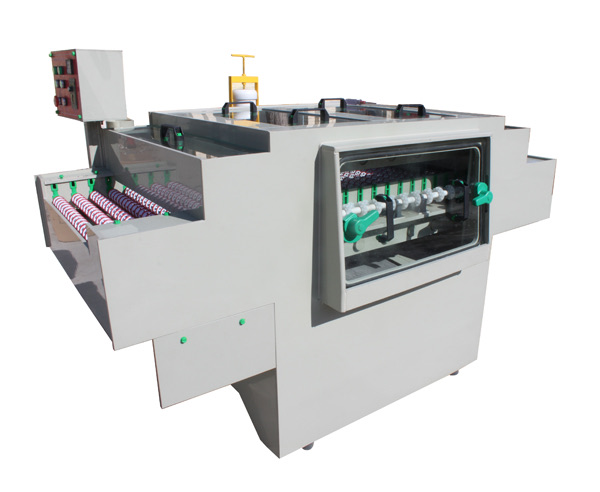
PFA-lined HF chemistry for Ti-6Al-4V bone plates and orthodontic implants.
| Etching process | Acid-based HF + HNO₃, PFA |
| Power | 45 kW / 380 V / 50 Hz |
| Working width | 650 mm / height 850 mm |
| Workpiece thickness | 0.2–8.0 mm |
| Conveyor speed | 0.5–6 m/min |
| Safety | HF leak sensor + Ca-gluconate tank |
| Cabinet | German PP, ≤100 °C |
Six things to read next — same chemistry, similar tolerances, or the next step in your process.
PEMFC BPPs — 316L / Ti flow fields at ±0.02 mm →
Ti / Inconel parts — AS9100 process documentation →
Medical-grade Cu / Kovar precision parts →
EV-grade precision parts — medical / automotive crossover →
316L enclosures, RFI shielding cans →
Titanium implants, orthodontic parts →
Send us your part drawing, alloy, annual volume and target finish. We'll spec the machine, the chemistry and the validation pack.