Precision Horizontal Etching Machine
- Etch area650 × 2000 mm
- Land/rib tolerance±0.02 mm
- Sheet thickness0.05–1.5 mm
- EtchantFeCl₃ (SST) / HF-mix (Ti)
- ModeSpray, batch
Best for FCEV R&D labs and small-series BPP runs.
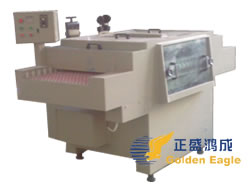
Photochemical etching lines for PEMFC and hydrogen-metal BPPs. Stainless steel 316L, titanium TC4, nickel-alloy and aluminium flow-fields — burr-free channels to ±0.02 mm, no heat-affected zone, no tool wear. GE has supplied BPP etching cells to FCEV programmes since 2014.
Metal bipolar plates (BPPs) are the volume bottleneck of every PEM fuel-cell stack — each stack contains 300–500 plates with 0.5–1.5 mm flow-field channels on 0.05–0.30 mm sheet. GE builds the etching machines that produce them. We supply standalone pilot cells for R&D and conveyorised horizontal lines running 1.2–4.0 m/min for series production, configured for your chosen metal, channel pattern and downstream coating line.
Stamping still dominates BPP mass production but it has three limits: (1) tool wear shifts land/rib dimensions every 5–10k shots, so fuel-cell performance drifts; (2) the punch leaves a defined burr that has to be polished off later, removing the work-hardened layer; (3) ultra-thin (<0.1 mm) titanium is hard to stamp without wrinkles.
Laser is fast but recasts the cut edge and is slow on serpentine patterns over large areas.
Photochemical etching is the obvious win on three points:
Two configurations depending on your volume: pilot, or production line.
Best for FCEV R&D labs and small-series BPP runs.
Best for series production of metal BPPs for FCEV passenger stacks.
Eight steps from coil to coated half-cell ready for stack assembly.
Slit & cut 0.05–0.30 mm 316L / TC4 coil into BPP blanks; alkaline degrease.
Dry-film photoresist laminated on both sides at 105 °C.
Double-sided UV exposure of flow-field artwork at ±5 µm alignment.
Spray Na₂CO₃ development — open channels in resist.
Spray FeCl₃ (SST) or HF-mix (Ti) — land etch ±0.02 mm, no burr.
NaOH resist stripping in closed-loop spray module.
Three-stage DI rinse plus hot-air drying.
Optical flatness scan, ICR spot-check, leak test before coating.
Cells 1–8 are integrated in a single conveyorised line. Steps 9–10 (passivation, PVD/CVD coating, diffusion bonding) are co-supplied as a turnkey line on request.
Each BPP metal needs a different etchant, etch time and tool material. Click through for the dedicated guide.
FeCl₃ etchant, regeneration-ready. Most common FCEV BPP metal. →
HF-based etchant, PFA-lined tank. Aerospace-grade stacks. →
Alkaline NaOH etchant. Low-temperature PEMFC, backup power. →
CuCl₂ etchant plus Cu²⁺ regeneration. Low-T backup-power stacks. →
Two configurations sit at the heart of every BPP production programme.
316L FeCl₃ etch + regeneration — the workhorse for FCEV bipolar plates.
| Power | 15 kW / 380 V / 50 Hz |
| Etching width | 650 / 1220 / 1550 mm |
| Thickness | 0.05–1.5 mm (thin land widths common) |
| Land tolerance | ±0.02 mm standard |
| Waviness | ±0.005 mm/m (TBC w/ inline flatness) |
| Tank volume | 800 L PP-lined with regenerable FeCl₃ loop |
| Throughput | approx. 600–2,400 plates / shift @ 300×300 mm |
| Line speed | 1.2–4.0 m/min |
| Cabinet | PP high-temp to 100 °C, full exhaust |
| Module sequence | Pre-treat → Etch → Strip → Wash → Dry |
For aerospace-grade stacks: Ti-6Al-4V TC4 plate with HF chemistry.
| Etching process | Acid-based HF + HNO₃, PFA-lined |
| Power | 45 kW / 380 V / 50 Hz |
| Working width | 650 mm / height 850 mm |
| Workpiece thickness | 0.2–8.0 mm |
| Land tolerance | ±0.02 mm (Hi-spec to ±0.005 mm) |
| Working temp | 35–55 °C |
| Conveyor speed | 0.5–6.0 m/min |
| Safety | HF leak sensor, Ca-gluconate tank, optional H₂-dehydro |
| Dimension | 8000 × 1700 × 1850 mm |
Six things to read next — same chemistry, similar tolerances, or the next step in your process.
Stents, scalpels & biopsy meshes — burr-free, ISO 13485 process →
Ti / Inconel thin-gauge parts — heat shields & acoustic liners →
EV battery shims, gaskets & sensor meshes — IATF friendly →
QFN / DFN QFP — half-etch + reel-to-reel inline plating →
Board-level shields, RFI strips, C194 / C7025 →
Ti-6Al-4V, PFA-lined HF chemistry — aerospace & medical →
Tell us your metal, channel geometry and annual volume. We will spec a pilot cell or a 4 m/min turnkey line — and we can quote etchant regeneration plus downstream coating cells.