Artwork
Send your CAD to a photoplotter; output is a film positive at 1:1.
Everything you need to pick the right photochemical etching machine for your part — the 14 GE machine models grouped by type, the four metals we etch most, the six industries that buy from us in volume, the spray-vs-immersion process question, and a step-by-step selection worksheet. Updated for 2026.
This is the manufacturer's guide to photochemical etching machines. It is written by GE — a China-based etching-machine builder with 20+ years of installation history, exporting to 30+ countries since 2003. The aim is to give you, the engineer or buyer, everything you need to choose the right machine without having to call us first. If after reading it you want to send a drawing for a free feasibility review, the contact page is the only thing you need next.
We will move from the basics (what an etching machine is, how it works), to the lineup (machines by type, by metal, by industry, by process), to the practical decision work: photo etching vs laser vs stamping, how to choose, what it costs, what the safety and quality system look like, and the most-asked questions from engineering buyers.

An etching machine is industrial equipment that selectively removes metal from a sheet using a chemical etchant and a photoresist mask. Where the resist is removed, the metal is dissolved; where the resist stays, the metal is preserved. The result is a precise, burr-free part produced at room temperature with no mechanical stress and no heat-affected zone.
The most common etchant is ferric chloride (FeCl₃) for stainless steel and cupric chloride (CuCl₂) for copper. Aluminium is etched in sodium hydroxide (NaOH); titanium requires hydrofluoric-acid-based chemistry with a PFA-lined cabinet. Every metal has a chemistry it likes — the same machine can run them all with a chemistry swap and the right wetted materials.
For a deeper primer, see our "What is an etching machine?" page, or skip ahead to the selection worksheet in Section 8.
Eight steps from a digital artwork to a finished part. Most machines integrate these into a single conveyorised line.
Send your CAD to a photoplotter; output is a film positive at 1:1.
Slit coil to blank size; alkaline degrease; rinse.
Hot-roll laminate dry-film photoresist on both sides.
UV exposure through the film — photoresist cross-links where the metal should stay.
Spray-develop unexposed resist; the “open” pattern is now bare metal.
Spray etchant — FeCl₃, CuCl₂, NaOH or HF — the open pattern is dissolved.
NaOH strip removes the cross-linked resist.
Three-stage DI rinse plus hot-air drying. Part is complete.
Read the full walkthrough on how photochemical etching works, or jump to the chemistry comparison at FeCl₃ vs CuCl₂.
GE builds 14 photochemical etching machine models in three families — single/double-side, precision horizontal/vertical, and continuous sheet or reel.
800×600 mm. Entry-level. Bubble/dabble. Etch one side, protect the other. More →
650 mm × L, ±0.02 mm. Halve etch time. PCB & nameplates. More →
650 × 2000 mm batch, ±0.02 mm. Shims, meshes. More →
650 × 4000 mm conveyor. Etch→Strip→Dry. More →
650 × 4000 mm, FeCl₃ / CuCl₂ with regen. More →
550 × 550 mm, ±0.01 mm. Stencils, encoder masks. More →
500 × 600 mm photoengraving for steel die moulds. More →
500 × 600 mm for hot-stamp moulds. More →
1500 × 3000 mm, SST / Cu decorative panels. More →
1.32–1.5 m wide. Continuous etched decoration. More →
Round workpieces, 35–200 mm dia. Rollers & tubes. More →
⌀600 mm. Watch cases, lighters, badges. More →
400 × 1000 mm, 0.02–0.10 mm foil. More →
25–650 mm × 8 m, half-etch precision. More →
Each metal has a sweet-spot chemistry, etch rate, and machine architecture. Four deep-dive pages cover the bulk of industrial demand.
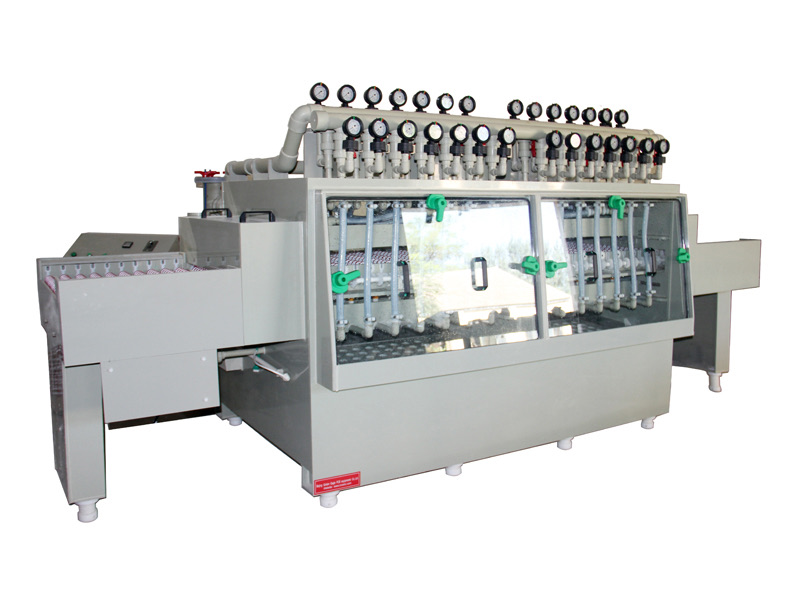
304 / 316L / 17-4 PH / 430 / foil. FeCl₃ at 38–45 °C, regenerable. ±0.02 mm. Used for nameplates, EMI shields, medical stents, fuel-cell BPPs.
C110 / C194 / C7025 / brass / bronze. CuCl₂ with electrolytic Cu recovery. ±0.02 mm. Used for PCB inner-layer, lead frames, EMI shields, EV current collectors.
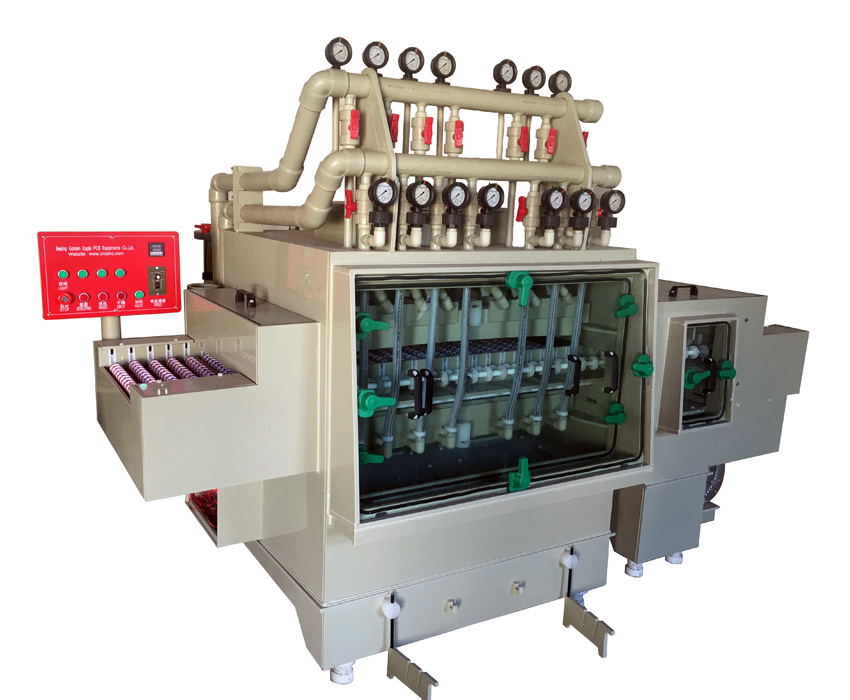
3003 / 5052 / 6061 / 7075 / foil. NaOH 8–12% wt. Closed-loop Al(OH)₃ recovery. Used for EV battery enclosures, signage, aerospace waveguides, decor.
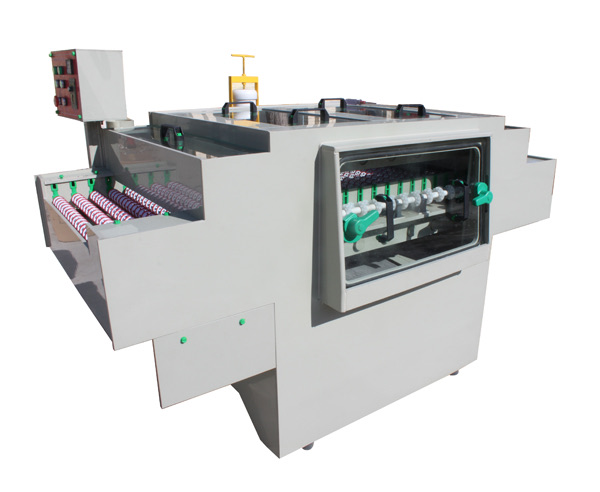
CP-Ti / Ti-6Al-4V (TC4) / Ti-3Al-2.5V. Hydrofluoric-acid chemistry, PFA-lined cabinet, HF sensor, Ca-gluconate neutralisation. Used for aerospace heat shields, FCEV BPPs, medical implants.
Six verticals account for 80%+ of GE shipments. Click through for deep-dive pages with line configuration, chemistry and tolerances.
PEMFC bipolar plates — 316L & Ti flow fields at ±0.02 mm. Fuel cell etching line →
Stents, scalpels, biopsy meshes, orthodontic brackets. Burr-free. ISO 13485 documentation pack. Medical etching machine →
Ti / Inconel gaskets, acoustic liners, satellite waveguides. AS9100-friendly documentation. Aerospace etching →
QFN / DFN / QFP lead frames with half-etch downsets. Reel-to-reel. Lead frame etching →
EV battery shims, gaskets, sensor meshes, FCEV BPPs. IATF-friendly documentation. Automotive etching →
Board-level shields, RFI finger strips, gasket frames. C194 / C7025. EMI shielding etching →
Two ways to deliver etchant to the work: spray (production) and continuous conveyor (volume). Both are stocked as GE standard lines.
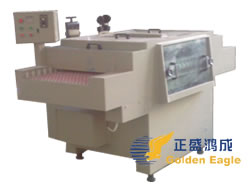
Fresh etchant pumped through oscillating nozzles onto the masked sheet. Higher etch factor, finer features, more consistent chemistry. Standard for production. Etch factor 1.5–4.0 depending on machine.
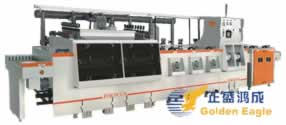
Conveyorised turnkey line — pre-treat, image transfer, etch, strip, wash & dry at 1.5–4.5 m/min. Throughput target ≈ 2 k m²/24h. Sheet or reel-to-reel.
Three processes compete for thin-metal parts. Here's the honest comparison.
| Dimension | Photo etching | Laser cutting | Stamping / die-cut |
|---|---|---|---|
| Min. feature | ~0.05 mm | ~0.10 mm (kerf-limited) | ~0.30 mm |
| Edge quality | Flat, square, burr-free | Recast, HAZ, micro-burr | Burr (deburred) |
| Heat-affected zone | None (room temp) | Yes (melting) | Work-hardened layer |
| Tool wear | None | Optics drift over time | Yes (re-sharp every 5–10k) |
| Best thickness | 0.02–2.0 mm | 0.5–10 mm | 0.1–3.0 mm |
| Setup cost | Film artwork (~$200) | Program (free) | Die ($5k–$50k) |
| Volume cost | Low (chemistry + resist) | Moderate (gas + lens) | Very low |
Rule of thumb: Pick photo etching for thin (<2 mm), precise, multi-feature parts and small-to-medium runs. Pick laser for thicker plate, single-feature cuts, or when chemistry is restricted. Pick stamping for millions of identical parts once the die is amortised. See the full precision & tolerance guide for the deeper dive.
Walk through this with your drawing and tolerances in hand. The answer at the bottom of each branch points to a specific GE machine.
304/316L stainless → FeCl₃ line (GE-JM650, GE-TS650).
Copper / C194 → CuCl₂ line with electrolytic recovery.
Aluminium 6061 → NaOH line.
Titanium → PFA-lined HF line.
0.02–0.10 mm foil → Super thin-plate.
0.05–2.0 mm → standard conveyorised line.
2–3 mm → heavy-duty custom build.
≥0.30 mm → horizontal precision line.
0.10–0.30 mm → precision horizontal.
<0.10 mm → vertical precision (stencil-class).
Sheet/panel batches → sheet line (GE-JM650-W).
Strip / coil 24/7 → reel-to-reel (lead frames, EMI shields).
Small parts / plaques → single-side.
Six industry pages cover FCEV / medical / aerospace / lead frame / automotive / EMI. Use them as the line selection shortcut.
AS9100 → aerospace page.
ISO 13485 → medical page.
IATF 16949 → automotive page.
All three ship as standard with every GE line.
Still unsure? Send a drawing — we will tell you which machine fits in 24 hours.
Bench-top laboratory etching machines start around USD 4,000–8,000. Production-class spray etching lines (GE-JM650 series) run USD 18,000–35,000 depending on chamber width and options. Reel-to-reel lead-frame etch lines run USD 80,000–250,000. Full turnkey lines for fuel cell bipolar plates, large-area decor, or continuous PCB production can exceed USD 1 M.
Operating cost is dominated by chemistry: FeCl₃ at ~USD 1.50/L (regenerable), CuCl₂ at ~USD 1.20/L (also regenerable), NaOH at ~USD 0.80/L (with Al(OH)₃ precipitation). Labour is approximately 1.5 hours per shift with preventive maintenance of about 4 hours per month per cabinet.
Typical ROI on a turnkey line is 18–36 months for a previously-stamped programme, and 6–12 months for a previously-laser-cut programme. Detailed worksheet — including throughput math — lives in our etching machine cost guide.
Modern etching machines are closed-loop systems: the etchant stays inside the cabinet, the operator interacts only through gloves and viewing windows, and exhaust is captured by a packed-tower scrubber.
Every GE machine ships with: (1) the MSDS for every chemistry tank, (2) the chemistry SOP with target Baumé/Cl⁻/free acid values, (3) the recommended PPE and the local exhaust requirement, (4) the IQ/OQ/PQ protocol templates for regulated buyers (AS9100, ISO 13485, IATF 16949), and (5) the structured Process FMEA template covering the etch cell.
For HF chemistry on titanium we also ship the calcium-gluconate neutralisation station, the HF leak sensor that interlocks the cabinet, and a 1-day on-site safety training module (calcium-gluconate gel — not water — for HF burns). See etching machine maintenance guide for the routine schedule.
Eight questions engineering buyers ask us most. Expand for the answer.
An etching machine is industrial equipment that selectively removes metal from a sheet using a chemical etchant (commonly ferric chloride or cupric chloride) and a photoresist mask. Where the resist is removed, the metal is dissolved; where the resist stays, the metal is preserved — producing precise, burr-free parts without mechanical force or heat. Full primer →
Photo etching uses a photoresist mask imaged by UV exposure — features down to ~0.05 mm with ±0.01 mm tolerance. Chemical etching in industry usually means immersion etching with a hand-cut or screen-printed mask — coarser geometry and lower tolerance. Every GE machine uses photoetching chemistry as standard.
Most engineering metals: 304 / 316L stainless steel, copper C110 / C194 / C7025, brass and phosphor bronze, aluminium 3003 / 5052 / 6061 / 7075, titanium CP and Ti-6Al-4V, Inconel / Hastelloy, Kovar and nitinol. Each metal has its own etchant; GE machines accept all of these with a chemistry swap. Stainless · Copper · Aluminium · Titanium
Standard GE lines handle 0.05–2.0 mm stock. Special heavy-duty etching machines go up to 3.0 mm, occasionally 5.0 mm. Below 0.05 mm we use the dedicated Super Thin-Plate etching machine. Above 2 mm we recommend laser or stamping.
On 0.05 mm 316L stainless, GE precision vertical etching machines deliver features down to ~0.04 mm with ±0.005 mm positional tolerance. As a rule of thumb, the minimum feature is roughly equal to the sheet thickness.
Dry etching (plasma / RIE) is sub-micron, semiconductor-grade; wet chemical etching is what most industrial buyers mean by ‘etching machine’; photochemical etching is wet etching using a photoresist mask. Photochemical etching is the right answer for >0.05 mm features, burr-free edges and high-volume industrial parts. Use dry etching only when sub-50 µm precision is mandatory.
Bench-top laboratory etching machines start around USD 4,000–8,000. Production-class spray etching lines (GE-JM650 series) run USD 18,000–35,000. Reel-to-reel lead-frame etch lines run USD 80,000–250,000. Full turnkey lines for fuel cell bipolar plates can exceed USD 1M. Read our detailed cost guide: etching machine cost guide.
Yes. Modern etching machines are closed-loop systems: the etchant stays inside the cabinet, the operator interacts only through gloves and viewing windows, and exhaust is captured by a packed-tower scrubber. GE machines include chemistry-level sensors, automatic dosing, interlocks, and waste-water neutralisation. We also ship MSDS, the chemistry SOP, and a recommended PPE list with every line.
Every "Etching Machine Guide" link above resolves to a dedicated cluster page. Here is the whole cluster, in order of search volume.
PEMFC flow-field etching. →
Stents, scalpels, biopsy mesh. →
304 / 316L FeCl₃ etching. →
C110 / C194 CuCl₂ etching. →
QFN / DFN reel-to-reel. →
Ti / Inconel parts etching. →
EV battery shims, gaskets. →
NaOH alkaline etching. →
PFA-lined HF etching. →
Board-level shields, RFI strips. →
Oscillating nozzle etch. →
Conveyorised 5-module line. →
Metal, thickness, tolerance, annual volume. We'll come back with the recommended machine, the recommended chemistry, and a ballpark price.